
This Is Us02 / 63
This is us
An independent healthcare agency built around a shared belief: the strongest ideas start with a better understanding of people. We work with pharmaceutical, biotechnology and healthcare organisations to connect complex science with the audiences who need to act on it.
An independent healthcare agency
Understanding13 / 63
One app with two routes in
Everyone with psoriasis gets the free app. A code from the care team opens a sixteen-week treatment journey, then hands the patient back to the app they keep. Patient organisations reach the people the clinic does not.
THE FREE ROUTE · anyone with psoriasis, via app stores, patient organisations and clinics · Australia first, May 2027
Finds the app
App store, patient organisations, clinic poster. No code needed.
Understands psoriasis
Education in plain words, revisited whenever it is needed.
Keeps track
Symptoms, triggers, photos, sleep, questions.
Brings it back
Appointment prep. Chooses what to show the care team. Repeats for years.
THE CODE · handed over by the care team at prescription · the only door between the routes
THE CODE ROUTE · patients prescribed the new treatment, via the care team only · after local product launch, Germany October 2027
Is prescribed
The care team explains the treatment and hands over the code.
Starts the journey
Sixteen weeks: daily routine, treatment chatbot, medication and refill reminders.
Habit established
Once a day, anchored to a moment they already have.
Keeps the app
Journey ends; the record, the routine and the next appointment carry on in the free route.
hands back
The free route carries no treatment content. The code route opens only after local product launch. Nothing on either route implies a treatment recommendation.
Understanding14 / 63
Living with psoriasis
A lifelong, relapsing condition that is visible to everyone and understood by few. The treatment journey is long, and for patient, the daily reality is longer.
THE JOURNEY
Onset
Often in the twenties or thirties. Plaques, itch, flaking. Years of “it’s just dry skin”.
Topicals
Creams and ointments, cycled for years. Messy, time-consuming, easy to stop.
Referral
Moderate to severe disease reaches dermatology. Phototherapy, then systemic treatment.
Systemic or biologic
Injections or infusions for many. Now a once-daily oral option. Reviews a few times a year.
Living with it
Relapses, triggers, comorbidities. Self-management between appointments, for life.
THE ONGOING CHALLENGES
Itch & sleep
Itch is the symptom patients rate worst; broken sleep follows it, and so do bad days.
Visible skin
Covering up, avoiding pools and short sleeves, being stared at. Stigma shapes work, relationships and confidence.
More than skin
Psoriatic arthritis in a minority; links to cardiometabolic disease; higher rates of depression and anxiety.
The daily grind
Treatment every day for years. Adherence drops as life gets in the way, and nobody notices until the next flare.
Unclear expectations
Patients rarely know what a new treatment should feel like, how long it takes, or what counts as normal.
Short appointments
Five to twenty minutes, a few times a year. Most of the condition is never seen by the care team.
Lebwohl MG, Bachelez H, Barker J, et al. J Am Acad Dermatol 2014;70(5):871–881.e30; Griffiths CEM, Armstrong AW, Gudjonsson JE, Barker JNWN. Psoriasis. Lancet 2021;397(10281):1301–1315.
Understanding15 / 63
Who treats psoriasis, & what they think of apps
Who decides whether a patient ever hears about PsoNuri, and what each of them needs from it.
| Who | Role in the journey | Mindset about an app | What it means for PsoNuri |
|---|---|---|---|
| Dermatologist | Diagnoses, prescribes and reviews moderate to severe disease. Introduces the new treatment and hands over the code. | Sceptical of pharma apps; will not add anything that costs consultation time. Wants to know in one sentence why it helps. | Lead with the benefit to their consultation. One line to say, one card to hand over, nothing to monitor. |
| Dermatology nurse | Runs follow-ups, education and practical support. The person patients actually talk to between reviews. | Pragmatic and patient-centred. Wary of anything that creates unpaid work or sends patients’ problems back to them. | Design for the nurse first: a guide that fits an existing follow-up, and clear limits on what the app does. |
| GP/primary care | First contact; manages milder disease and repeat prescriptions; refers when it is moderate to severe. | Sees few psoriasis patients, under time pressure. Needs short, defensible information and a clear referral path. | Free-app awareness only. Simple, approved information they can pass on without explaining. |
| Pharmacist | In some markets, dispenses the treatment and may hand over the access code. | Wants a clear, repeatable step that fits dispensing. Will not advise beyond their role. | A handover script and card that work in a pharmacy, where relevant by market. |
| Patient organisations | Psoriasis Australia, Deutscher Psoriasis Bund, IFPA and local groups. Reach patients outside the clinic. | Trusted by patients and cautious of pharma motives. Will scrutinise what is in it for patients before sharing anything. | Offer the free, unbranded route and a toolkit that is theirs to edit. Partnership, not placement. |
Understanding19 / 63
Five levers to keep patients coming back
How PsoNuri can turn what patients record into support they can feel
PsoNuri
POTENTIAL SUPPORT LAYER
01Sleep & wellbeing.
Psoriasis is tied to poor sleep, low mood and lost confidence, and the itch is often worst at night. The app already records sleep and wellbeing. It could also offer short night-time routines, plain-language content on itch and sleep, and signposting to patient organisations. It records how someone feels; it does not assess or treat it.
02Flare support.
Patients say the hardest part is the flare nobody warned them about. The app records flares. It could also offer care-team-approved “what to do now” content, a simple look back at what came before the flare, and clear guidance on when to contact the care team rather than wait for the next appointment.
03Life beyond the skin.
Clothes, swimming, summer, work, relationships, the question “what’s that on your arm?”. Patients describe these as harder than the skin itself. The app could offer what to say when someone asks, planning for exposed-skin moments, and guidance on talking to an employer. Nothing here mentions treatment.
04The patient’s voice.
Make it easy to say what the app gets wrong. In-app feedback, a patient panel in co-creation with patient organisations, and a visible “you asked, we changed” note in each release. The clearest signal that the app is a companion and not a monitor.
05Treatment support, between appointments.
The weeks after prescription are when the questions arrive: what should this feel like, is this normal, what if I missed a day. Alongside the sixteen-week journey and reminders, the code route could offer approved answers to the questions patients ask most, what to expect and when, and a clear line on when to contact the care team. All of it approved product information, behind the code.
These are reasons the free app stays on the phone after the sixteen weeks.
Launch27 / 63
The tactics, & why they matter
Thirteen tactics in three phases.
PHASE 1 · LAUNCH · Australia, May 2027 · Establish the free app with patients and patient organisations
| Tactic | For | Behaviour it moves | Why it earns its place |
|---|---|---|---|
| Landing page & FAQ | All patients | Understand what the app is and who it is for before downloading | One approved source of information on what the app is and how to access it |
| Explainer video | All patients, advocacy | See how the app is used in everyday life | Shows the app’s value in under a minute; reusable across clinic, social and partner channels |
| Social posts | All patients | Become aware of the app and try it | Reaches people with psoriasis who are not currently in contact with a specialist clinic |
| Patient-org toolkit | Advocacy groups | Recommend the app to their communities | Trusted by patients, and able to reach them through channels Takeda cannot use directly |
| Launch moment | Advocacy, press | Raise awareness of life with psoriasis, then of the app | Earned attention for the patient experience, with the app as the practical response |
| In-app messaging | All users | Keep using the app after downloading it | The campaign’s voice and messages continue inside the app, agreed with the software team |
PHASE 2 · EXPAND · Germany, October 2027 · Secure recommendation at prescription. Treatment-specific: reaches patients only via the care team and the code
| Tactic | For | Behaviour it moves | Why it earns its place |
|---|---|---|---|
| Rep training | Field teams | Demonstrate the app accurately in two minutes | The quality of the first demonstration determines whether a clinic adopts the app or dismisses it |
| Rep demonstration | Doctors, nurses | Understand the benefit and agree to recommend | A short demonstration of one patient using the app is more persuasive than a list of features |
| Clinic leave-behind | Care team | Recommend the app consistently after the visit | Keeps the reason, the eligible patient and the handover steps in front of the team |
| Code card / handover | Prescribed patients, via the care team | Download the app and activate the treatment journey | Makes the code part of the prescription conversation, not a separate administrative step |
| Nurse follow-up guide | Nurses | Use the patient’s record at follow-up appointments | Gives nurses three questions that fit an existing consultation, without adding time or monitoring |
PHASE 3 · MAINTAIN · From week sixteen, every market · Sustain use beyond onboarding
| Tactic | For | Behaviour it moves | Why it earns its place |
|---|---|---|---|
| Patient stories & community content | All patients, advocacy | Keep the app in use, and in conversation, long term | Real experiences from early users give later patients a reason to start and to stay |
| Market-in-a-box | Local teams | Launch consistently in each new market | Launch logic, key messages, sequence and assets, so new markets do not start from scratch |
Every tactic keeps the two routes apart: free psoriasis support for everyone; treatment content only behind the care-team code.
Creative / The reveal29 / 63
Clarity that continues. Brought to life.
One ambition.
Two creative routes.

Creative / Route 01 / The idea30 / 63
Behind the creative
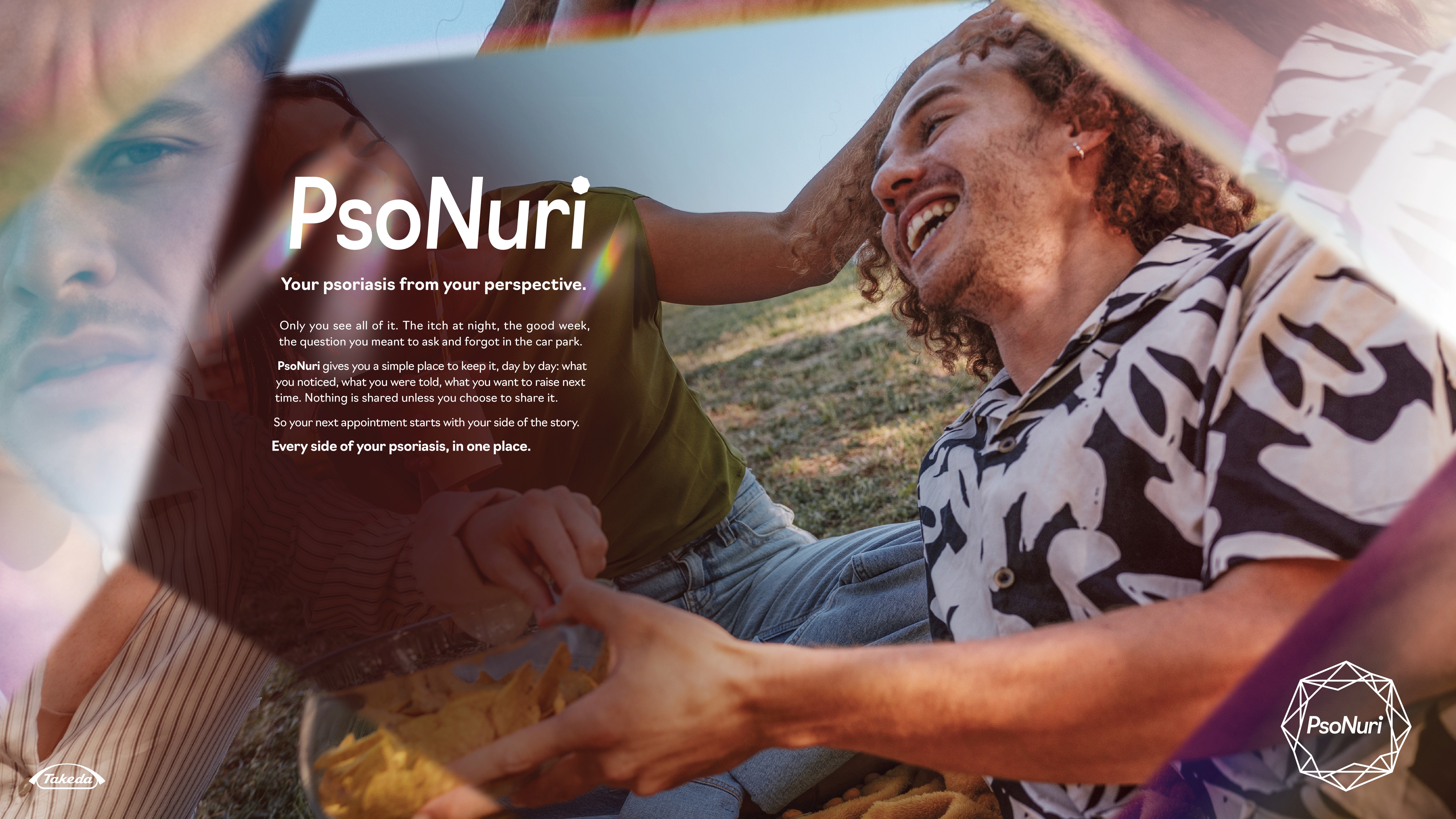
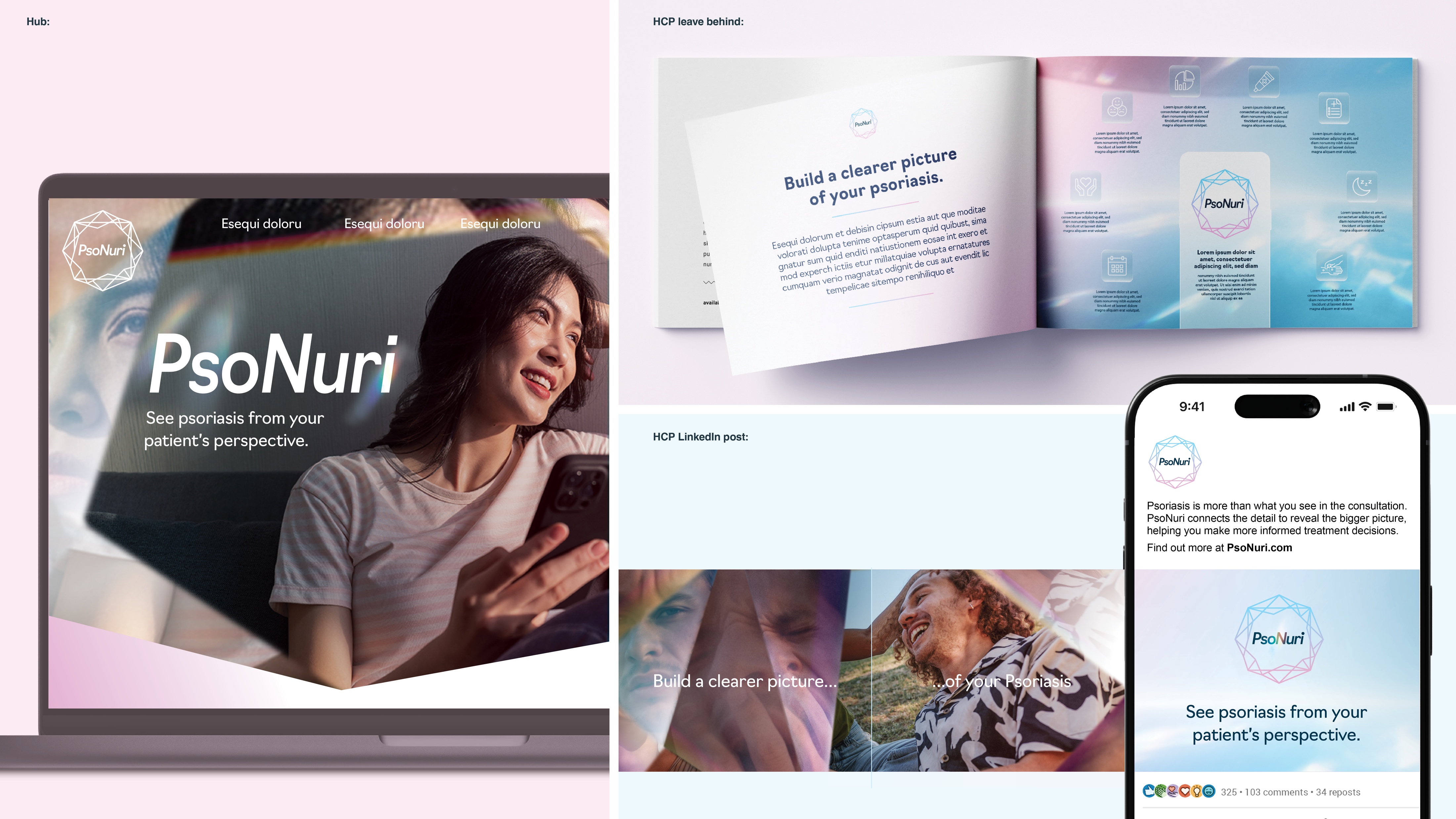
Psoriasis, from
every perspective.






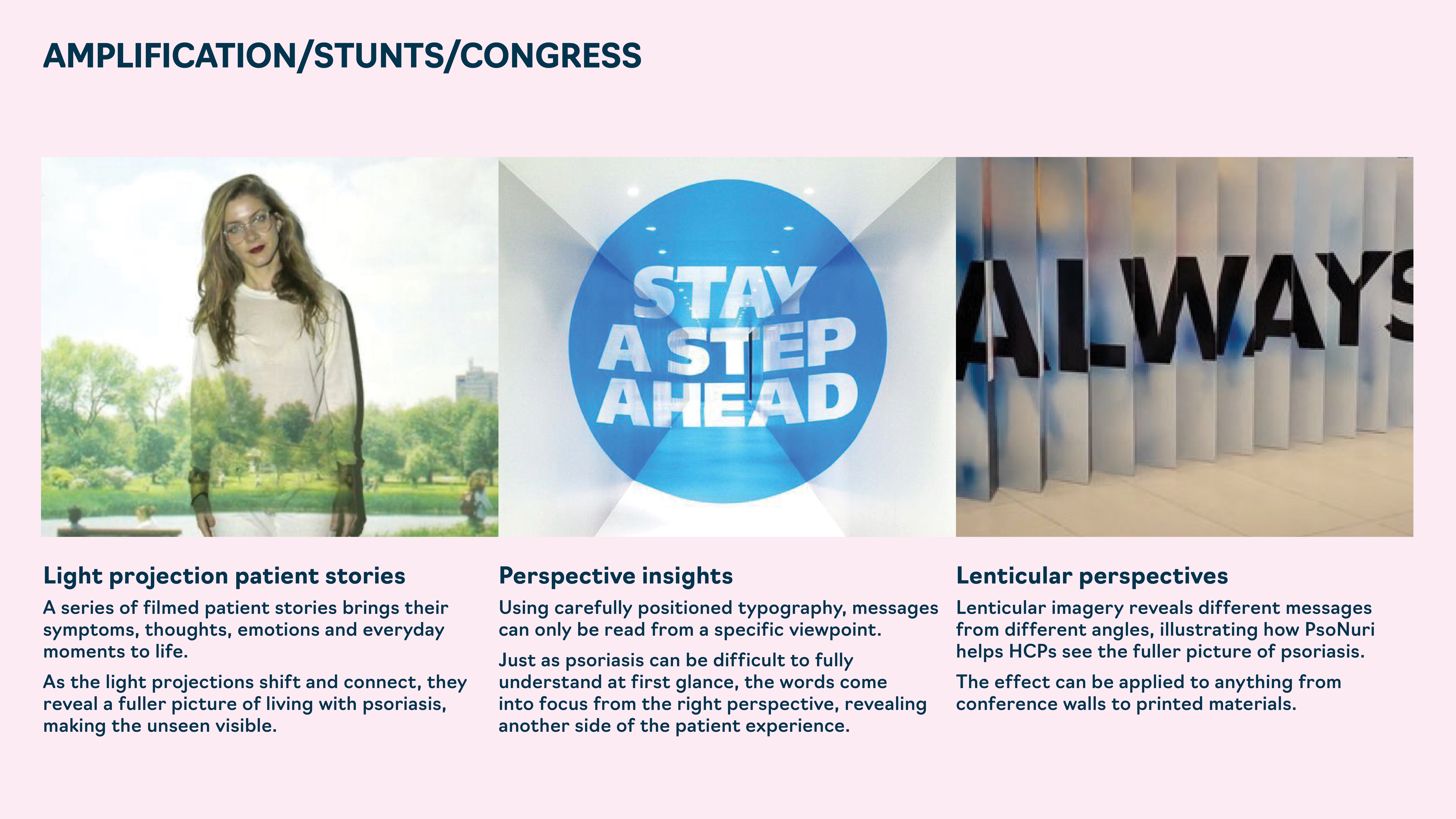
Psoriasis is visible on the skin, but most of it is lived out of sight: the itch, the nights, the worries, the days that never come up in a ten-minute appointment. Only one person sees all of it. The patient.
Like a crystal, the human form shows a different face as it turns. Each facet is one of the patient’s own perspectives on their psoriasis: a good week, a bad night, a question they meant to ask. Every one of them belongs to them. For a patient starting a daily treatment, the facets include the ones the care team most needs to see: the week nothing happened, the day the tablet was missed.
PsoNuri gives patients a simple way to record those perspectives, day by day, and to choose which ones to bring to their care team. Nothing is sent to the clinic. Because when the care team sees psoriasis directly from the patient’s perspective, there is more to understand, discuss, and act on.
Creative / Route 01 / The film31 / 63
Psoriasis, from every perspective.
THE FILMCreative / Route 01 / The print campaign32 / 63

Creative / Route 0133 / 63
Creative route 01
Psoriasis, from
every perspective.

Creative / Route 02 / The idea34 / 63
Behind the creative
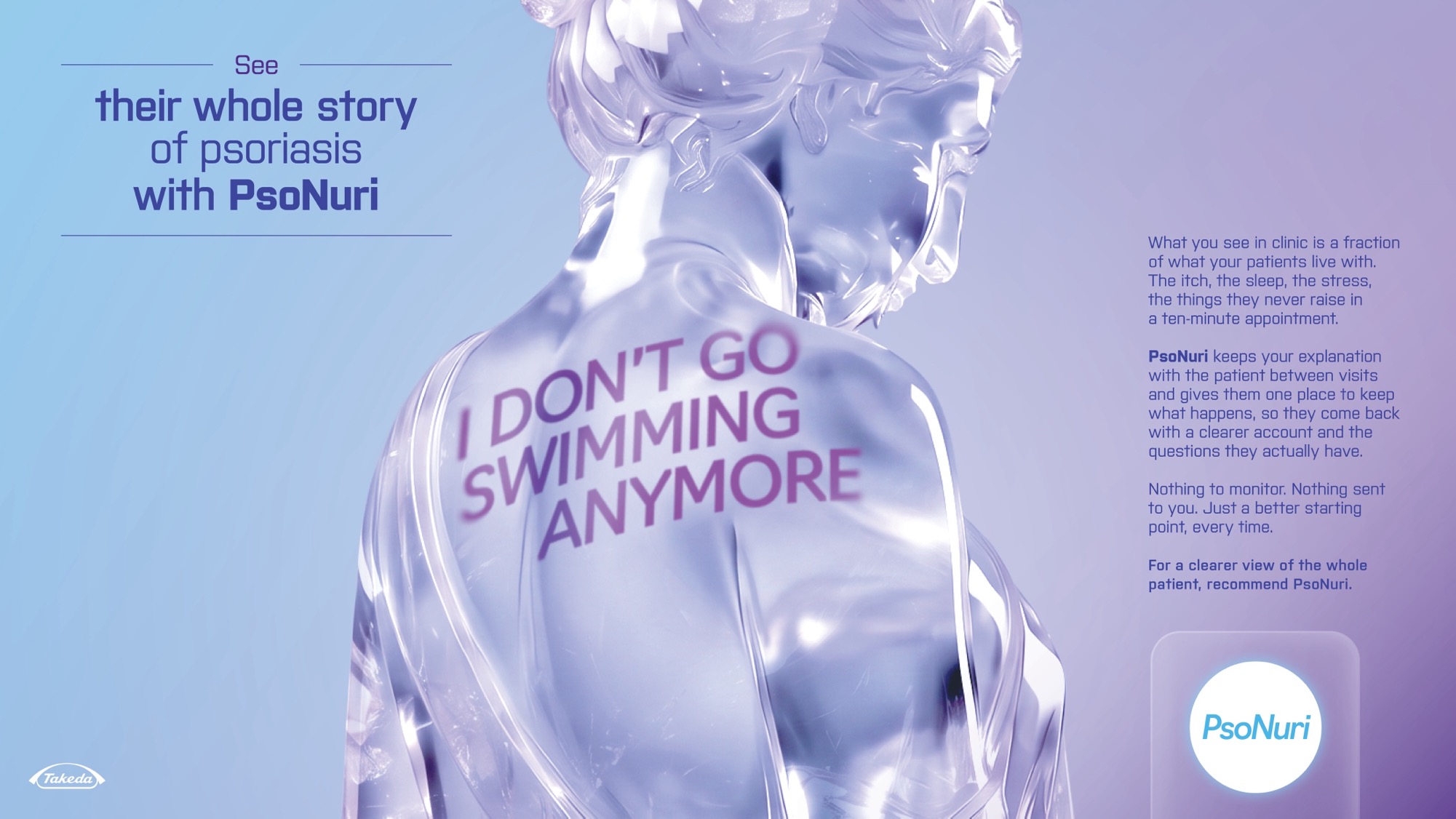
The whole story.






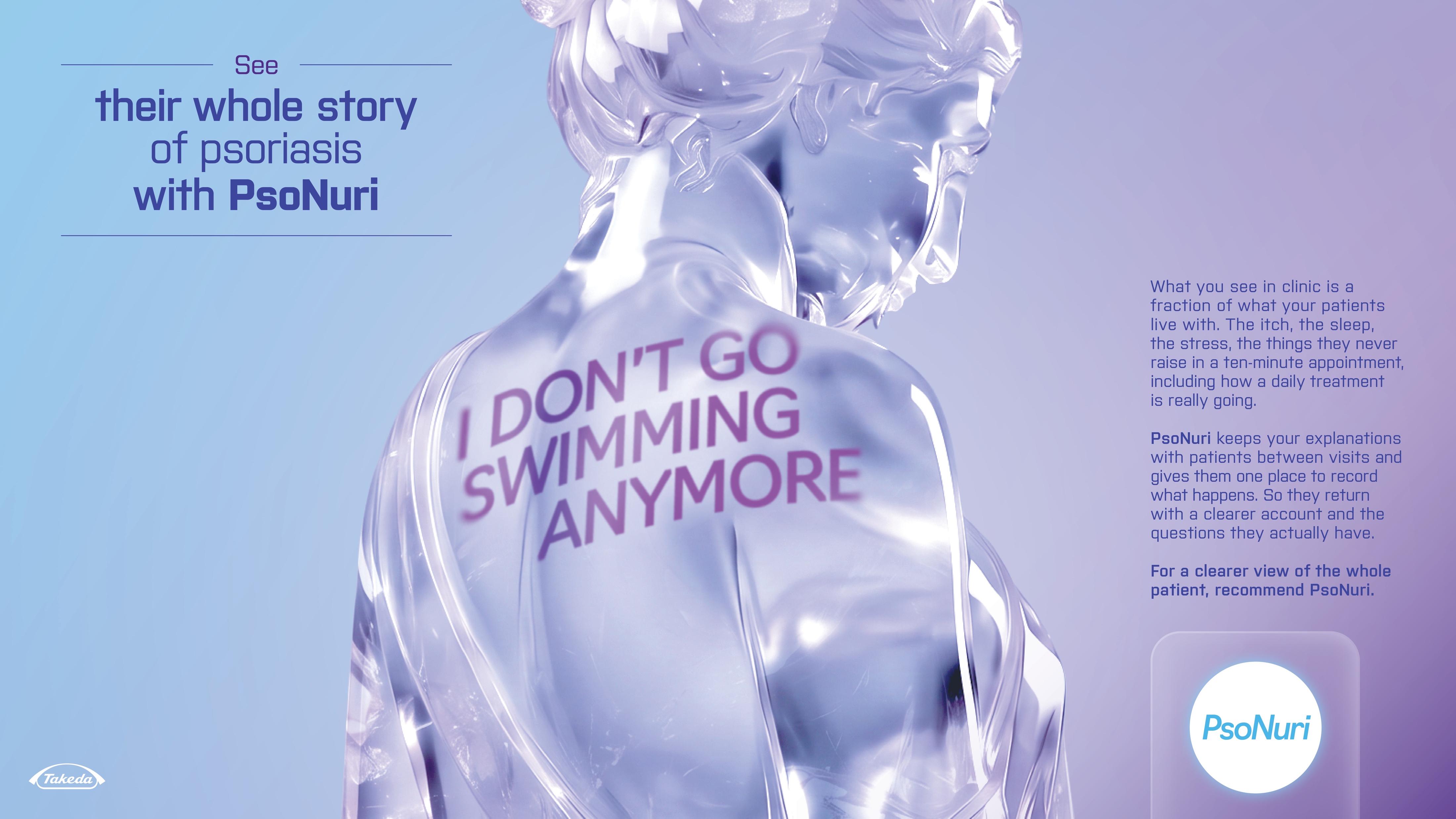
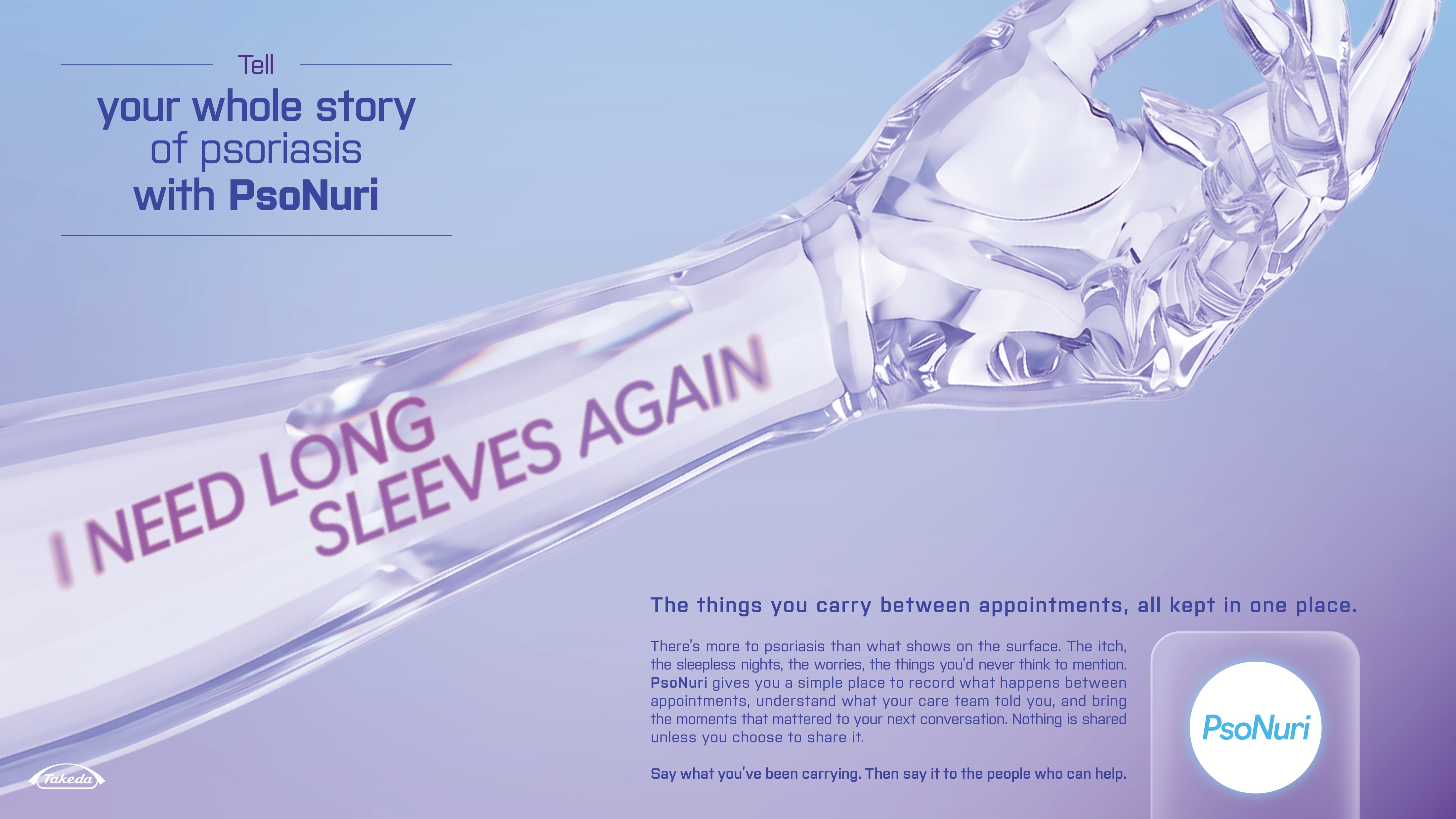
Psoriasis is more than what appears on the skin. There are the symptoms. The stress. The worries. The impact on everyday life. The things patients experience, think and feel, but don’t always get to share.
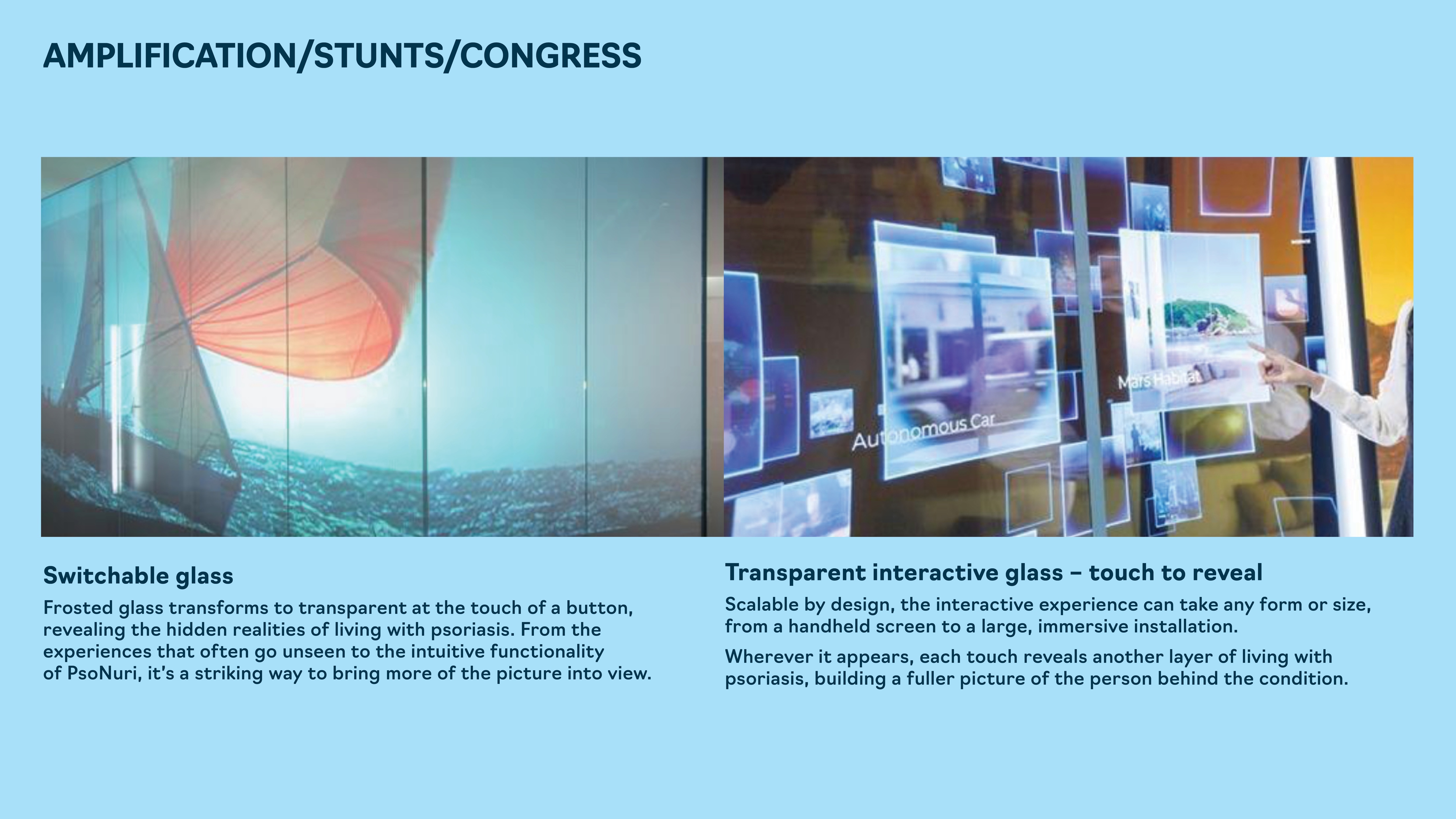
We bring these unseen realities to life through powerful human forms made from glass. Each figure holds the words of a life with psoriasis. Not labels, but the things patients might think but rarely say: “I’m dreading the beach.” “I need long sleeves again.” “I stopped taking it in week three.” “Is this normal?”
For patients, it says: ‘We know there’s more to your story.’ For care teams, it reveals the part of their patients’ lives they rarely get to see, including whether a daily treatment is being taken.
PsoNuri gives patients a simple, private place to capture what happens between appointments and bring what matters to their next conversation, as and when they choose. Because when more of the story is shared, there’s more to understand, discuss, and act on.
Creative / Route 02 / The film35 / 63
The whole story.
THE FILMCreative / Route 02 / The print campaign36 / 63
Creative / Route 0237 / 63
Creative route 02
The whole story.


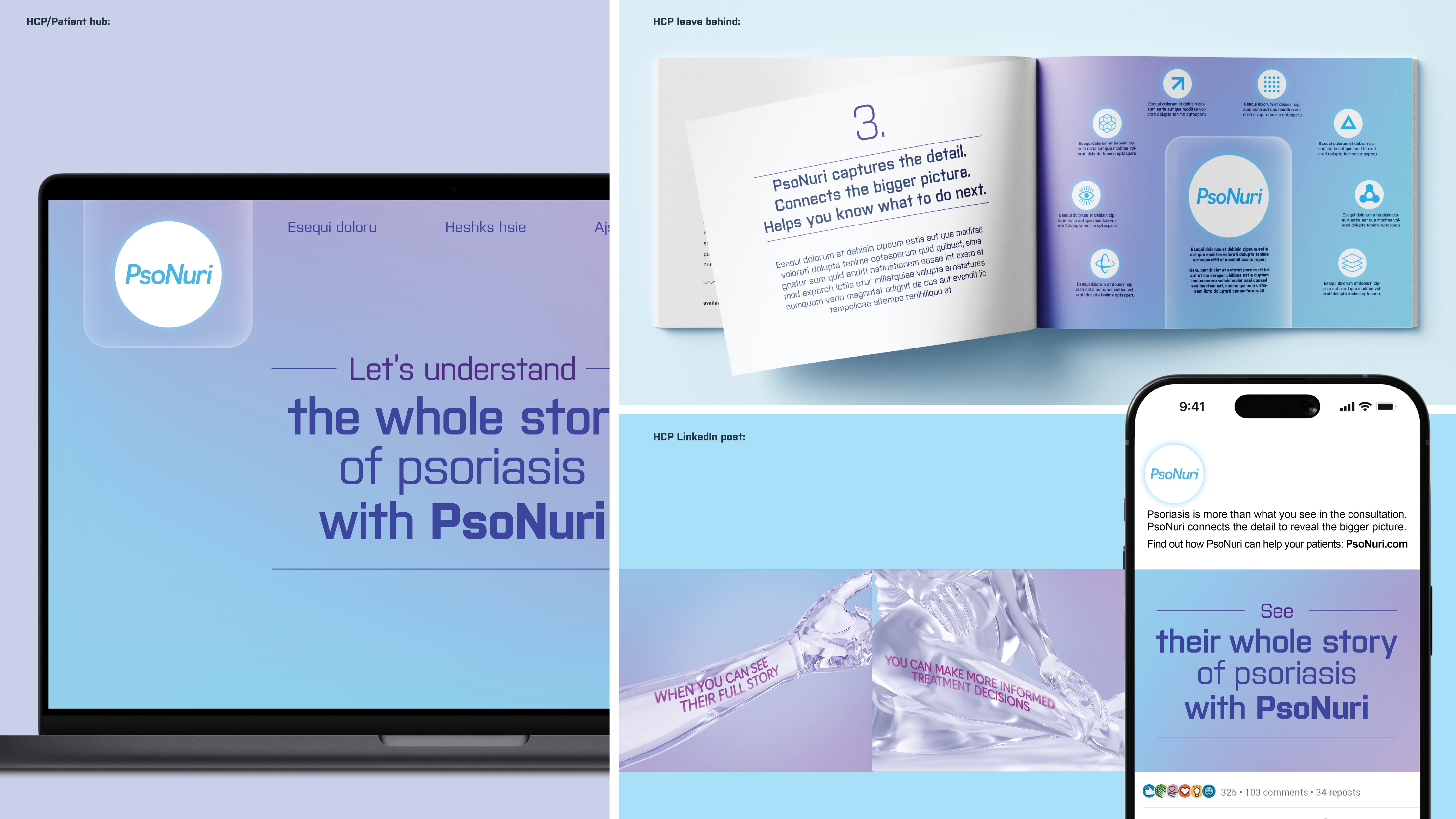
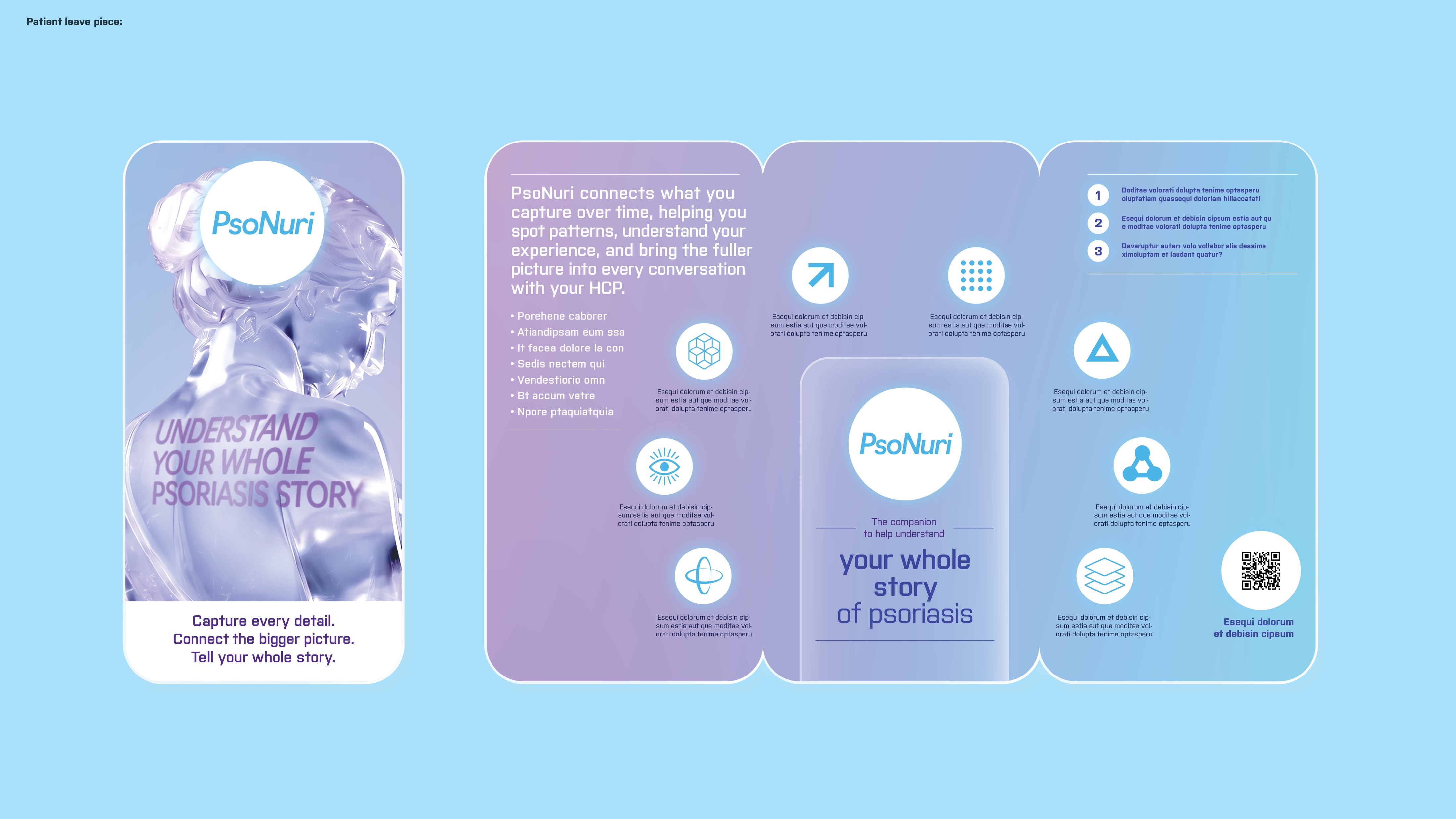
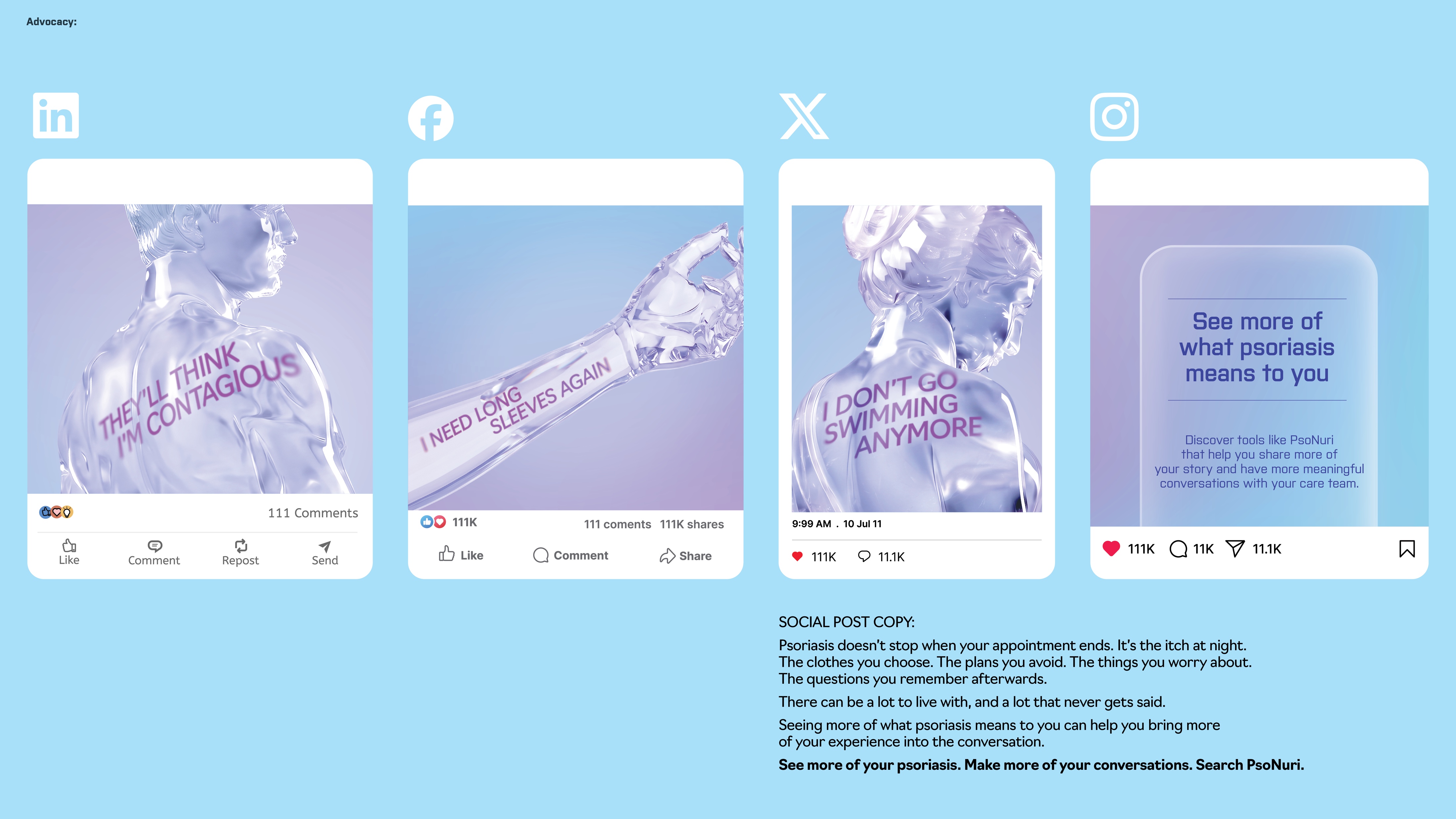
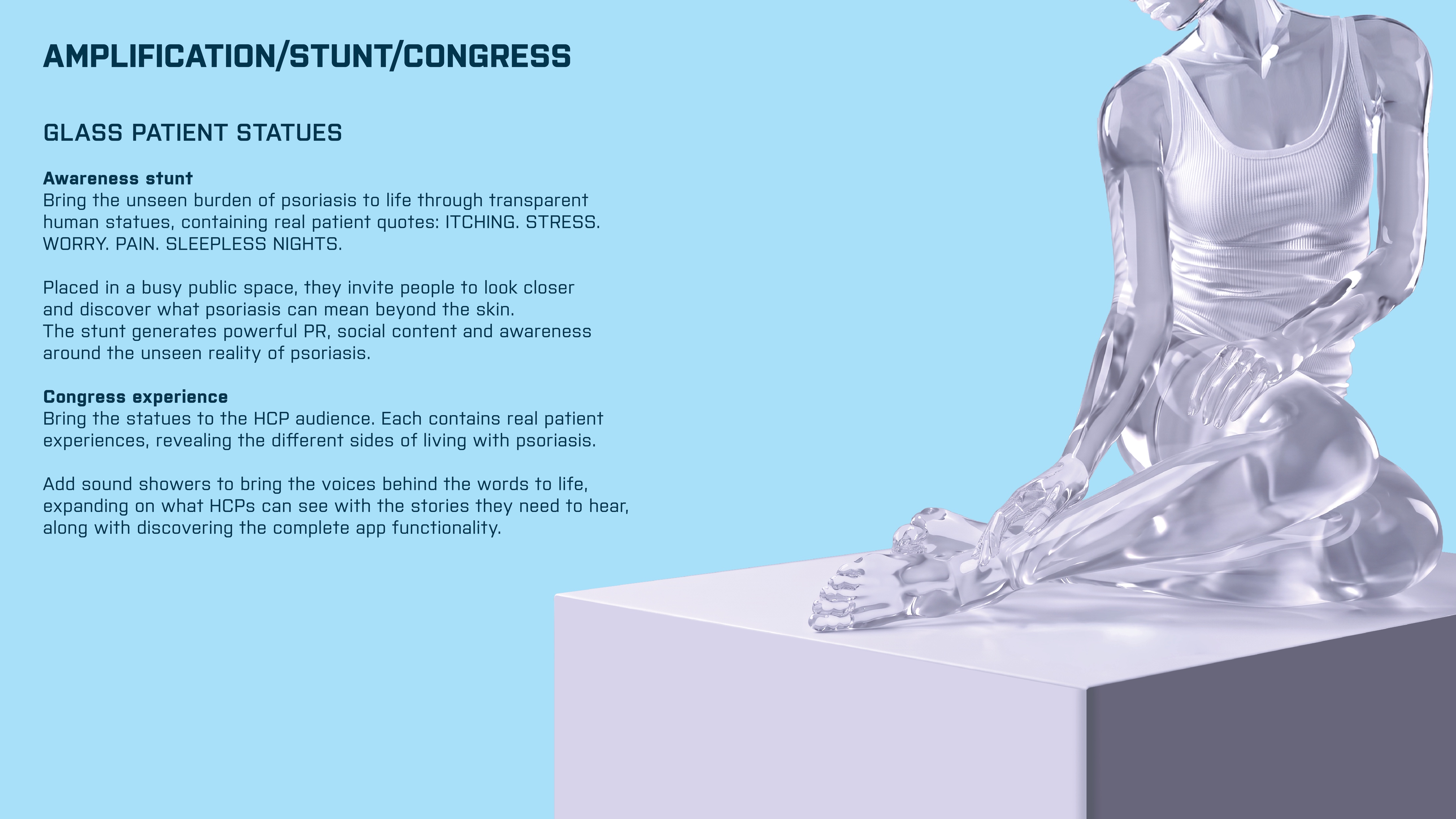
Creative / Route 02 / Inside the app38 / 63
Daily conversations
One-to-one connection, personalisation, documentation
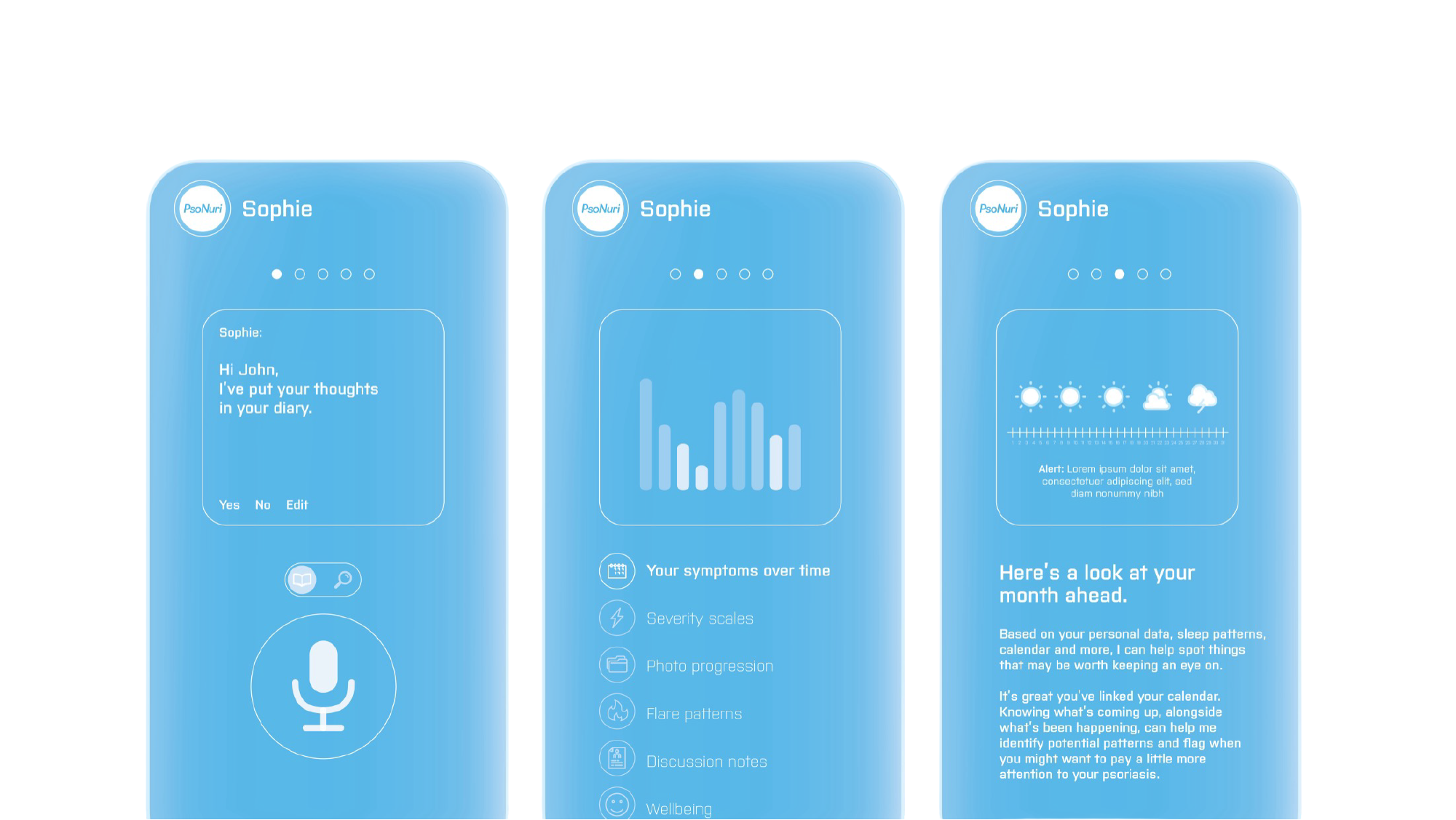
Analysing the past
Dashboards of personalised insights
Looking ahead
Using all the data to predict possible flares in the future
02 / PRODUCTION52 / 63
A clear production
schedule
Campaign development, review and readiness.
02 / PRODUCTION TIMELINE53 / 63
A clear production schedule
Campaign materials ready before each launch, with time for local adaptation,
medical and legal review, revisions and care-team training.
2026 → 2027
OctNovDecJanFebMarAprMayJunJulAugSepOct
Brief, creative route and asset planOct–Dec 2026
Copy, scripts and storyboardsJan–Feb 2027
Design, video and digital productionFeb–Mar 2027
Australia: local review and revisionsMar–Apr 2027
Australia: final files and trainingApr 2027
Germany: content and adaptationJun–Aug 2027
Germany: local review and revisionsAug–Sep 2027
Germany: final files and trainingSep 2027
Planned launches: Australia May 2027. Germany October 2027.
Proposed production windows. Confirm asset volumes, review rounds and product readiness at kick-off.
03 / LAUNCH54 / 63
A clear path to launch.
From Australian launch to the full German application.
03 / LAUNCH TIMELINE55 / 63
A clear path to launch
Proposed campaign phases around the brief’s planned launches:
unbranded support in Australia, then the full German application.
Strategy &
co-creation
Agree scope, journeys and measures with Takeda and local teams. Test messages with doctors, nurses and patients.
Materials &
approval
Create the market toolkit, KAM scripts and nurse/patient aids. Localise, coordinate PromoMats review and train launch teams.
Australia
launch
Launch unbranded psoriasis support. Track recommendations, onboarding and useful engagement. Gather patient and care-team feedback.
German launch
preparation
Apply Australian learning. Separately test prescription access and onboarding. Approve German materials and prepare local care teams.
Germany
full launch
Launch with zasocitinib, subject to local readiness. Activate prescription support and code handover. Track use through follow-up.
Later markets follow local launch readiness, with a reusable toolkit and learning from each wave.
Indicative phases after selection. Launch dates follow the September 2026 brief and remain subject to confirmation.
05 / APPENDICES56 / 63
Supporting detail.
Scripts, delivery considerations and the decisions ahead.
APPENDIX A / THE COMPLETE KAM SCRIPT57 / 63
A conversation that can stand on its own
Illustrative wording for development and local review.
The KAM should adapt the opening to the team’s stated needs.
Discover & explain
“What is hardest to clarify when patients return?
PsoNuri combines education with a patient diary, so patients can revisit information and keep their experiences and questions together between appointments.”
Demonstrate & agree
“That gives your team something to discuss alongside your usual assessment. Can I show you the patient journey?
Then we can agree who would introduce it and how you could revisit it at an existing follow-up.”
Optional line to test: “Continue the education beyond the consultation.” Avoid promising a shorter consultation.
APPENDIX B / OBJECTIONS58 / 63
Trust requires clear answers
Some questions need a verified operational answer before the campaign can ask a care team to recommend PsoNuri confidently.
“Will this create more work?”
Propose use at an existing contact and test the handover effort. Do not promise zero work. If a patient needs setup support, agree who provides it and where technical help sits.
“Am I expected to monitor this?”
The brief does not establish remote monitoring or a clinician portal. Define the service model explicitly. Do not imply that recording information alerts the care team.
Other launch-critical questions: privacy, data access, patient suitability, accessibility and the route for urgent concerns.
APPENDIX C / PRODUCT AND CLAIM CHECKS59 / 63
What must be confirmed before production
The strategy can be clear while release details remain open. Resolve these points with Takeda and the product team before approving demonstrations or field materials.
Functionality & access
Confirm the launch feature set, code workflow, help route, supported languages and accessibility. Verify what patients can display or share and what clinicians can actually access.
Evidence & responsibility
Confirm approved education, safety wording, data handling and ownership of updates. Test any claimed reduction in repetition or time. Treat the one-minute handover as a design target.
The 16-week journey is in the brief. A one-minute recommendation and reduced workload are not established evidence.
APPENDIX D / DELIVERY AND INVESTMENT60 / 63
€250,000 indicative agency scope
A planning allocation within the brief’s ballpark. Final volumes, market adaptations and external costs require joint scoping.
Strategy & creative development
€45kAudience, journey and measurement strategy
€45kCreative platform and message development
€30kConceptual design and content system
Delivery & coordination
€80kPrioritised campaign asset development
€30kProject and market coordination
€20kReview and localisation support
Total €250k. Paid media, app engineering, translation and external filming/research costs require separate agreement.
APPENDIX E / WORKING MODEL61 / 63
A shared team with clear decisions
TIU develops the strategy and campaign with Takeda, the software team and the first launch markets. Nurses and patients should help test whether the journey makes sense.
TIU responsibilities
Strategy and creative leadership, with medical writing and evidence review. Experience and content design, supported by production and project coordination. Proposed roles require named allocation before submission.
Takeda & partner responsibilities
Takeda and local teams own approvals and launch decisions. The software team confirms functionality. Patient and clinical contributors test relevance, comprehension and workflow fit.
Submission dependency: add confirmed team biographies and verified digital-health case studies. These were not supplied.
APPENDIX F / DECISION AND PROVENANCE62 / 63
The decisions that make the campaign executable
Agree the proposition, priority behaviour and proof requirements before commissioning the full asset suite.
Decisions for the launch team
Endorse “Clarity that continues” as a route to test. Confirm patient eligibility and professional roles. Approve the first-use and follow-up demonstration. Agree what evidence would justify scaling.
Basis of this proposal
Takeda PsoNuri GTM & Launch Campaign Brief and PsoNuri OnePager, supplied September 2026. Strategic framing, scripts, workflow examples and budget allocation are proposals, not approved claims.
Plain meaning throughout: clearer understanding for the patient, a clearer picture for the care team.
TIU / PsoNuri63 / 63
Clarity that continues.
Thank You
THIS IS USBack to the beginning ↑